Saturday, March 23, 2013

The most amazing NGO. Ever.

This past week I went to Varanasi, Uttar Pradesh. While there, I was in what SIT calls "workshop" where I got to know an NGO on a deeper level by spending an entire week investigating and researching their practices. The research included conducting interviews, getting debriefs from unit directors and also observation.

The 27 people in my program were (for the first time) split between four different workshops. Everyone was able to attend their first choice workshop and I chose to go to Varanasi and research the Kiran Center; the most amazing NGO ever.


To explain the NGO in a nutshell ... Kiran is an empowerment program for the differently abled and underprivileged. Kiran educates, rehabilitates, and trains "young" people and their parents to increase their quality of life and their integration into society.
The website doesn't do this organization justice, but you can check it out at http://kiranvillage.org

Because you can't get a great picture of the awesomeness of Kiran from the website, I am going to try to relay a portion of the vast amounts of information that I gathered this past week. Because Kiran is just too cool, I don't think this is going to be a short post ... just consider yourself warned.


All Kiran buses are maintained by the automotive unit.
They are cleaned twice a day and all mechanical fixing
takes place within the NGO by the vocational
trainees/teachers.
To start off each day, we (the four other girls and an SIT staff member - who is actually from Varanasi - and I) boarded Kiran buses in town to take us the 45minutes to the Kiran Village. Along the way we picked up countless students and everyone crowded in. There were three buses for students and one for teachers. Each bus for students had a driver and a male aid. If when picking up a child from their "stop" s/he was physically handicapped (60% of the students at Kiran are disabled in some way, and the majority have physical impairments), the aid would elegantly whisk the child from the street, up the steep stairs of the bus, and put them into a seat. In the US, these children would be on "the short bus" with seat belts or restraints; in India, these children were squished on to normal school bus seats and were perfectly fine and happy.

One of the other girls (Miyena) and I rode a bus together one morning. The kids were super fun (as you can see by her face) and we loved interacting in Hinglish.
I couldn't resist putting this cutie on here.
There were so many adorable children!
When we arrived at Kiran each morning, there was an enormous "welcoming" squad of teachers, aids, and students to help all the kids off the bus and into their wheelchairs, walkers or off and running to morning "prayers".

"Prayers" were less religious and more spiritual. They had some quite meditation, some food for thought by famous people (e.g. Gandhiji) and the school moto. This was student led and everyone at the school attended.

There are five main departments of the Kiran Village which I visited during the week: Integrated Education, Special Education, Vocation and Skills Training, Rehabilitation, and Human Resource Training Center.

The doorway into the Lower Kindergarden classroom.
Eye-spy: extremely motivated and studious girl in the
back in a special seat made (on site) for her condition.
Kiran's philosophy is that students of all abilities should learn together - integrated education. There are two main units within the education department, Integrated Education and Special Education. In Integrated Education, all of the "normal" students (which must be below the poverty line) are taught with "differently abled" students. Most of the "different" students have physical impairments. All students are placed based off of skill and not on age. However, there are no 13 year olds in the first grade; most students are within a year of a typical school/grade age. Right now the school only educates up to 7th standard, but plans to increase to 8th next year. After 8th standard, the goal is to have students capable of attending further education outside of the NGO.

The special education department consists of five sections: Academic, Functional Juniors, Functional Seniors, Self Care, and Hearing Impaired.
In the Academic section, special needs students learn academic information at a slower pace and with special needs based methods. In the Functional Junior/Senior (groupings based on age) students learn some academic information but skills are also concentrated on personal skills and social skills. The Self Care section (which serves the most sever cases) teaches personal skills like going to the bathroom, brushing ones own teeth, or feeding oneself.
The Hearing Impaired section has two levels, and trains students to lipread Hindi. The students have their own style of sign language that they all use to communicate with each other and with staff (if the staff lets them use it), but because the goal of Kiran is to train students to integrate and succeed in society, they learn how to lip read and speak (there is an onsite speech therapist along with the teachers).

The methods that Kiran uses are wonderful. I was able to observe four different levels and saw discussions, songs, activities, one on one help, and a simulation.


Physically challenged women in the Art and Design unit
paining a silk scarf which was designed by a MR artist.
The Vocation and Skills Training department has ten sections: Woodworking and IQ Toys, Horticulture, Tailoring, Orthotics, Physiotherapy, Art and Design, Saksham Grihini (capable housewife), Food Preservation, Bakery, and finally Learn and Earn. Participants of the department are 16-30 years old and have varying degrees of mental and physical ability.

It would take forever to go into detail here about each program, but in general: each program has between 1-3 years of training and some  also have an internship for a year after training. The goals of the Training department are to integrate people of different abilities into society and also be able to contribute to society. Once a trainee graduates, they are qualified to take out an interest free micro loan from Kiran to start their own business.
The different units of the Training department all create different products which are sold in the Kiran Center in town (and online). Everything made in the units are made or designed by someone of differing abilities.
Also, Kiran is amazingly sustainable. For example, the basic weaving that the MR (mentally retarded) students make in the Learn and Earn unit, are then used as a fabric for the Art and Design unit to make purses.

The fourth department, Rehabilitation, has eight different units: Orthotic Workshop, Outreach Service,  Mother's Training, Physiotherapy, Parent and Child Care Unit, Community Based Rehabilitation, Dispensary, and Hostel for Outreach.
I won't go into much detail on each of these but I do want to highlight three of them briefly.

As I mentioned above, the majority of students (and many staff members) have physical impairments. To be maximally functional, different "appliances" are needed. Because they are needed, Kiran has a workshop on site that addresses this need and provides them free of charge for everyone. At the workshop (which is staffed by professionals and Kiran trained persons) they make custom orthoses, custom protheses, custom spinal braces and jackets, hand splints, custom gaiters, shoe modifications, wheelchair repairs and modifications, and also repair any other appliances.
The main room (of two) for the Orthotic Workshop.

The second unit I want to touch on is the Physiotherapy Unit. Each student in the school (total of 240) that have a physical impairment, receive physical therapy. Depending on their need and their potential to improve, each child is given an individualized therapy schedule. There are trained and licensed physical therapists, occupational therapists and also trained assistants. One assistant in particular is deaf, and she was a student at the school and went through training with the Vocation and Skills Training department and now works with physically handicapped students.
The main Physiotherapy room. There are also other facilities: a therapeutic playground, a trampoline, a horse for therapy, and a therapeutic pool.

A third unit of the Rehabilitation Unit is the Parent and Child Care Unit (PCCU). Here there is a team of a special educator, occupational therapist, speech therapist, phycologist, and neurologist.  Each day, parents from the village and community bring in their disabled child (up to 25 years old) to the Kiran campus and the team assesses each child. They work on home-therapy plans, medical plans, and possible enrollment in the Education Department or the Vocation and Skills Training department.

The fifth and final department is the Human Resource Training Center (HRTC). One of the main themes that we noticed from all of our interviews with department heads and Sister Sangeeta (the Swiss nun who founded Kiran) was that Kiran's focus is on quality and not quantity - and after 20 years, they have now stopped expanding and only want to make their services as wonderful as possible. Because they aren't going to expand themselves, they decided to have some way to create expansion. That is what the HRTC is for. The HRTC hosts a college accredited program to train people to become special educators. The program is two years long, only accepts 25 people a year and preferences handicapped and poor applicants.

Wow, that was a lot of info, yet I feel like I only got to scratch the surface with this post.

I would like to add one last thing. A plug.
As you can imagine, running all of these programs plus so many other aspects that I didn't have room to mention (like daily lunches for all 400something members of campus, or hostel units) all requires money. I would never ordinarily ask people to give money to anything. However, I feel like I have to make an exception. If this post has intrigued you at all, please look into Kiran more on their website, ask me questions, and if you can, donate to this AMAZING NGO!

Tuesday, March 19, 2013

The City of Varanasi

First Impressions:
              • pungent smell
              • hot
              • tons of flies
              • very different than the India I have experienced thus far.


Although those adjectives could be considered negative, I really don't mean them to be. For the oldest city on earth, she isn't doin' too horribly I suppose. The people are very nice, I can find chocolate, and the tourists are differently obnoxious than in other parts of India.

However, there is literally trash everywhere; there is so much pollution that it can be hard to breathe; and the city itself doesn't feel as spiritual as you'd think it would be or have heard it is.


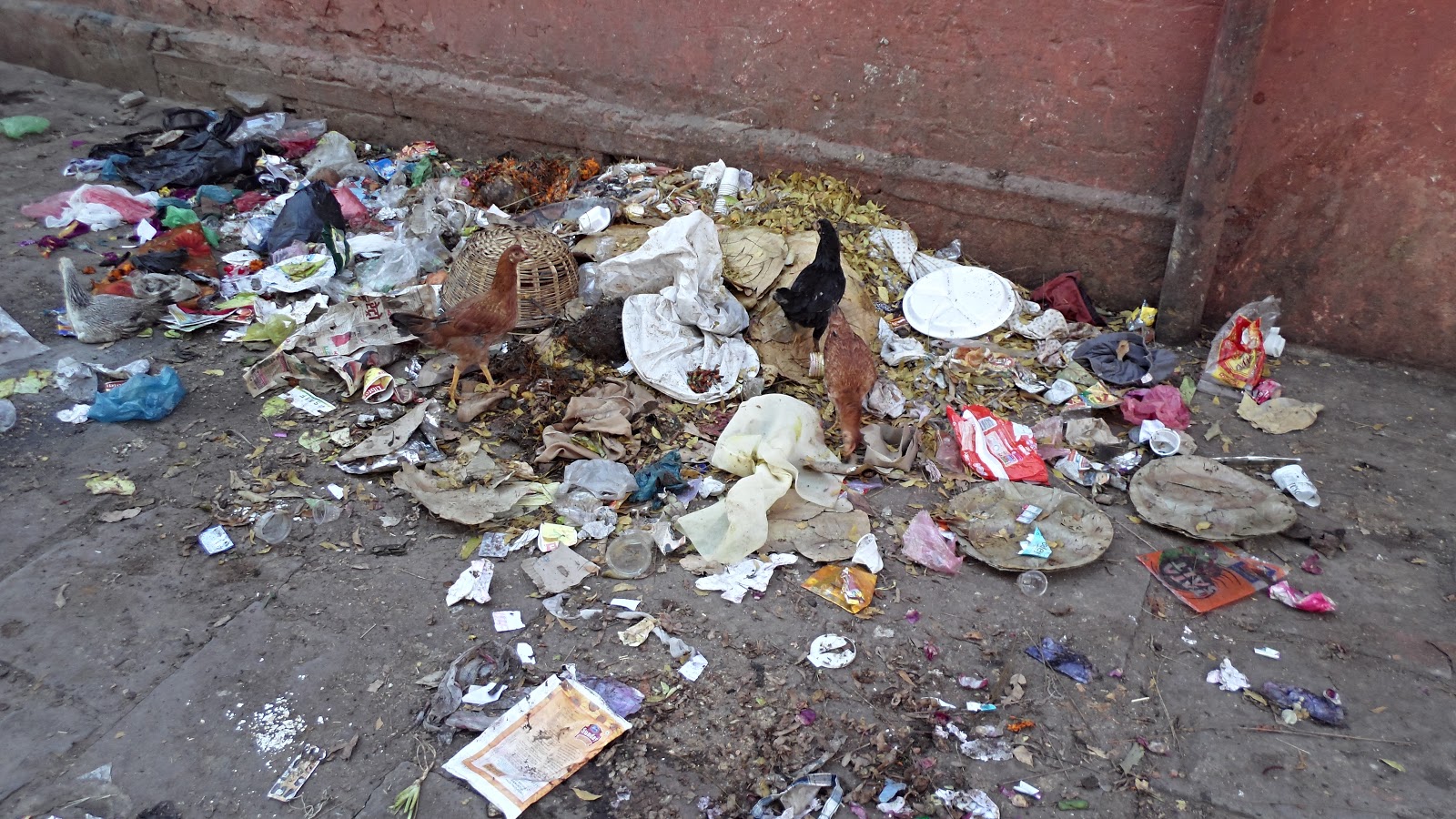
This is an example of the trash/animal life on the streets here. Eye-spy: 4  scrawny chickens

That is not to say that the city isn't cool to walk around and see. Above is a pic of a fruit and veggie stand. Like the rest of India, there are people selling all sorts of things on the streets.

When you're in Varanasi, you can't not walk along the Ganges.
It is said that if anything were to be constructed on the other bank of the river, the city would no longer be holy. So, everything is crowded onto the one bank.


We went to the Ganga Aarti the first night, which was a very "I'm visiting Varanasi" thing to do. It was entertaining, but because one of the girls I was with was having a hard time breathing with all of the pollution and incense, we decided to leave after about 30 minutes.


All in all? This is a fine city. I don't think it is wonderful, but I'm glad I'm getting to see it.

Side note: Despite the "sight-seeing" quality to this post, I really am here to conduct research and observations on an (AMAZING) NGO called Kiran. More on that later ...

Friday, March 15, 2013

Indian Bathrooms!

I am about to head off to Varanasi for a week of research with an NGO, but before I go, I thought I should post a little something.
If you know me, you know that bathrooms are very important to me. I judge places by their bathrooms. 
Before coming to India I was very nervous about the idea of using an "Eastern Latrine." But now, I much prefer the Eastern toilet to the Western, and will even wait in line to use the Eastern before using the Western. The eastern is so much more hygienic!
Here are some pics of the restroom facilities I've been using and also a wonderful little video tutorial.

This is the bathroom at my home here in New Delhi. It is very nice. I can flush the toilet paper (which we keep on the counter because there is no paper holder), we have a working shower (no bucket showers for us), and the hot water geyser (which you can see in the corner of the mirror) heats up within 20 minutes.
If you notice though, there is no shower curtain. This is not unusual. In India, there are drains in the floor, and because I live in a posh place, there is a floor squeegee that we use to remove the water.
Also take note of the little hose next to the toilet. That will be explained below.

This is a medium quality Eastern style restroom at a market here in Delhi. There is a trashcan for toilet paper or other papery products; there is a flush button and running water to fill the mug (the pink thing to the right).

Here is the most Indian toilet ever. This is the toilet on the train!
See that hole? Well that hole is directly open to the tracks down below (it was night when I took the picture so you can't see the tracks). There are directions to not use it while the train is stopped because you would be doing your business at a station and people would see everything dropping from the train car. This wouldn't be extremely unusual to see, but I guess it is the Indian train system's attempt at being more civilized. 
It is actually set up very well. There is a handle to steady you while you are squatting/rocking with the fast movement of the train, and there is very strong soap and Indian water available to wash your hands pre-handsanitizer.

Finally, here is the video that we first watched to learn how to use the Eastern Latrine, which we now have learned is "very very clean."
Whenever I watch this with Indians, they laugh hysterically at the South Indian doing the tutorial, but we found it quite educational.
Enjoy.


Sunday, March 10, 2013

Excursion to Rajasthan

This past week we took an excursion to the state of Rajasthan. We learned about some state and traditional medical programs and also NGOs. We also did a ton of fun sightseeing and activities.

Our little group in the sleeper compartment on our 12 hour overnight trip from Delhi to Rajasthan.

The view from my hotel while in Udaipur.

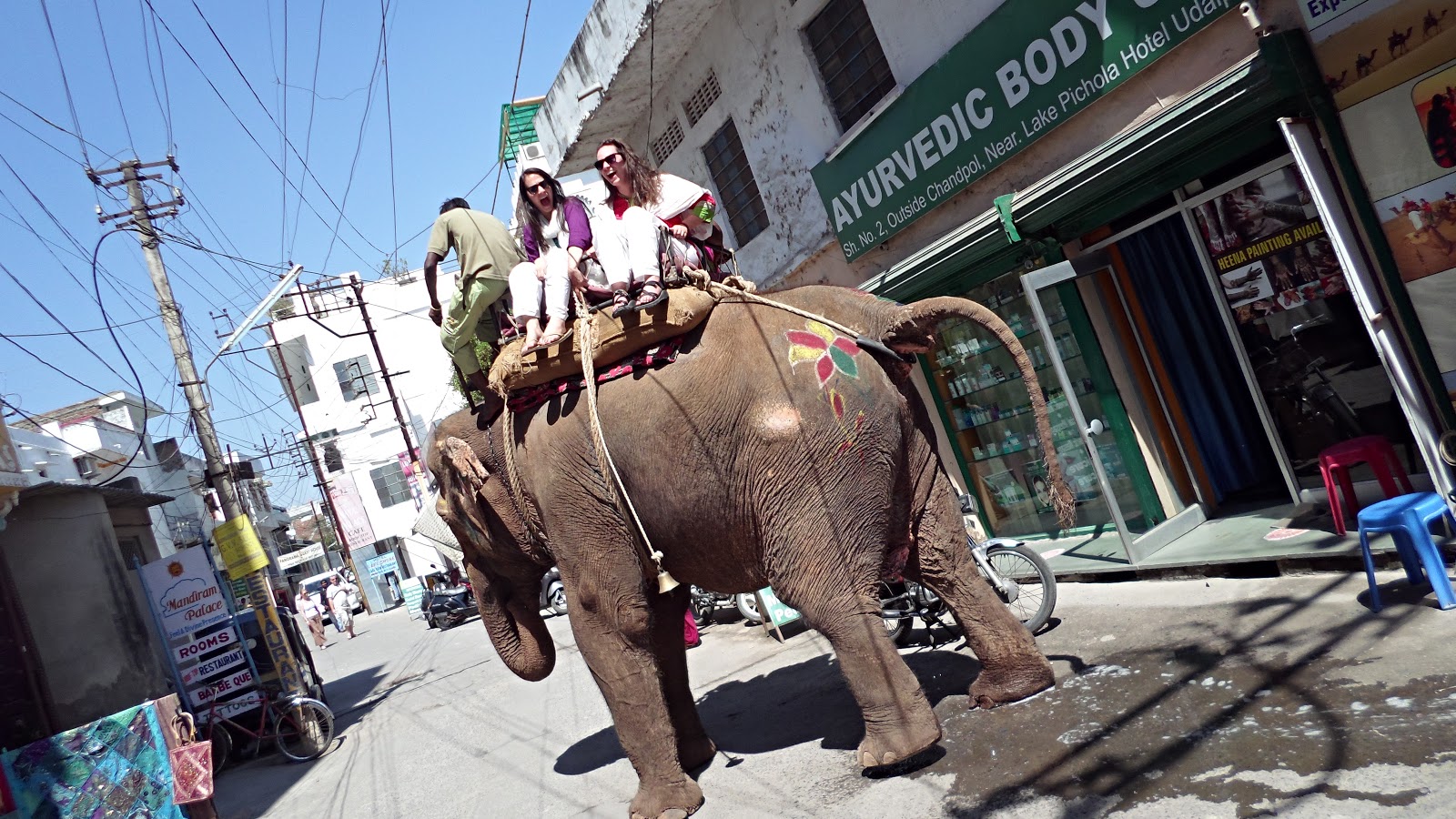
While in Udaipur, we got to ride an elephant through the streets! She took a little (3 gallon) pee break in the middle.

In Udaipur, we went to a hospital that had a pediatric malnutrition clinic. Here, mothers are paid "wages lost" each day (IR130, about 2.75USD) to take care of their children under the doctor's directions. Here they get medication and food.

Next to the hospital in Udaipur, there was a breast milk donation center (brand new NGO) and also a place where babies can be abandoned. The picture above is the crib that has a censor with a two minute delayed alarm. Someone can drop off the unwanted child and walk away before the alarm goes off for an NGO worker to collect the child. This is an effort to reduce the number of children who are abandoned out in the desert of Rajasthan.

We visited two different villages in Rajasthan, one in Udaipur and one in Devgarh. We saw how a government funded NGO runs a mobile clinic, and also how a privately funded NGO runs Balwadies, which are similar to the function of the Anganwadies.

On our final afternoon in Rajasthan, we visited the Chittorgarth Fort.

There were multiple locations to the Fort and this one reminded me exactly of the monkey secene of the Jungle Book. Including the carvings and structures ...


... and all the 100s of MONKEYS!!!

Sunday, March 3, 2013

Becoming a Pro in India

Yesterday (Saturday) some friends and I decided to get out and explore. It's also my friend's 21st birthday today, so we decided to go out to dinner since we will be on an overnight train to Udaipur tonight.
What struck me the most about yesterday was how integrated and comfortable I felt.

The girls and me (minus Priyanka who took the picture) on the platform before entering the mosque.

We decided to venture out to Old Delhi again to visit Jama Masjid, the largest mosque in India.
A month ago, the idea of going to Old Delhi was a trek - two different Metro lines and then navigating the craziness of the area. Now, it was no sweat. The jostling and pushing to make it on to the metro was practically normal.
We then walked out to the main street, and because we didn't know exactly where the mosque was, we decided to take rickshaws. I am very conflicted on my feelings towards rickshaw walas, but I do know for sure that white-tax is in full swing, so I have no problem negotiating-down a price. Sarah decided to take the lead on this particular negotiation and was awesome.
She asked how much to Jama Masjid, and the wala said "100 Rupees." (outrageous)
"Bahoot Bahoot! [too much!] 40 Rupees."
The wala replied "No. 50 madam, Indian price." Ha!
"We live here, that is not Indian price. 40 Rupees."
"Ok ok [with the added Indian head shake/nod]."

So, we then got on the rickshaws and went for a ride through the crowded streets of Old Delhi.
It was quite the ride including going down some steps and riding through a crowed market (which was kinda awkward).

Part of the market leading up to the mosque. See the Red Fort in the background?

As we waited for one of our friends to join us, we hung out on the steps to the mosque. There, little girls begged for food and money. Weeks ago I would have really struggled with what to do as they were tapping or pulling on my arms. Now though, we calmly said, "Nahee Nahee" (no no), and they eventually went away for a bit (and returned relentlessly).
They were pretty well off little beggars. They were getting plenty of free food from the stands and the leader of their little pack, who also was the smallest, had a huge wad of cash hidden away under her kurta.
There was a tourist woman sitting on the steps waiting for the evening prayer to be over and was shaking her head at the girls. In the Western world, a shake of the head means "no." But in India, a shake means "yes." Julia and I went over to her to give her some advice, and it turns out that she was a  very nice French woman here on vacation. We had a quick covo after shooing the girls away, and then went back to our friends.

The wall of the Jama Masjid

Once prayer was over, we removed our shoes to go into the mosque. However there was another Indian scheme to get money from "tourists." 300 Rupees for anyone who had a cell phone or a camera. Now, there are more cell phones in India than toilets (fact), so every Indian going into the mosque most likely had a cell phone, but no Indian was stopped. However, all white/foreigners were stopped for a bag check and forced to buy a ticket.
This seemed absolutely ridiculous to us, so we schemed right back. We split up the group, and half of us went in at a time and the other half watched the stuff. Before I went in, the "guards" didn't believe me that I didn't have anything. I showed them I had no bag, so where would I have a phone? He made me promise that I was telling the truth, and then I was allowed in.
It was quite cool. Very big, but also looked a lot like the Red Fort. The most amazing part of it was thinking that this marble and sandstone has been here since 1656. We walked barefoot around for a while (trying to avoid the great amounts of bird poop everywhere), and then went back out.
I must have looked like an authority of the place because as we were waiting for the other half of our group a British woman came up to me to ask my advice about the price to get in. She also wasn't dressed appropriately (her arms were showing) so she was forced to put a hospital gown type thing on to cover up (haha).

The buildings of the city surrounding the mosque
Once we were done looking around. We decided to walk though the market and the crowded city streets back to the Metro station. On our way back we saw a white woman alone, looking a bit confused and holding an India guide book. I called out to her to see if she needed help.

We made it back to the Metro station with no problems and hopped on. I had to go to Lajpat Nagar to pick up my new spectacles (as they call them here, see the pic to the right) and also some more hand sanitizer before the trip to Udaipur, so I stayed on the Metro a bit longer. I ran my errands and then an hour later navigated to Khan Market to meet up with the girls for the birthday dinner.

It was an easy and fun day. A month ago I probably looked as overwhelmed as the woman on the street with the guide book, and now I casually walk down the streets and can offer help to other people! Its amazing what has happened in only a month.
I am loving India.

Friday, February 22, 2013

Rural Excursion: Levels of Health Care in Aligarh

This past week we went on a four day excursion to Aligarh, Uttar Pradesh. Along with our cultural adventures (interacting with the women of Aligarh Muslim University, a wedding reception (which I was too sick to attend) and a cultural-music performance), we visited the entire range of health delivery services that exist in India.
Before I continue, let me preface by saying that this is a super detailed and intricate system with many details. I don't plan on going into too much detail here; but as always, if you have a question about something specific, please leave a comment and I'll do my best to respond.

To see the first level of care, we visited a small village.

The very first and basic level of health delivery is provided by the Ashas, a volunteer government position. This level of health care delivery is relatively new (2005) and has been extended to 2017. At that time the system will be reviewed.
An Asha is a woman (who is married and has at least one child) who lives in the community and has leadership ability. Being an Asha is voluntary, but there are certain government perks to meeting goals. The women are elected by the community and they must pass the screening tests. They also receive increased respect from the community and there are reports that say that being an Asha is a source of pride for a woman.

To the right is a picture of a woman with her newborn (40 days old) getting a wellness visit from the Asha. The Asha asks a series of questions like what you would associate with a typical pediatric check up (heart rate, breathing, temperature, rashes, latching for breastfeeding, ect.) but she uses no tools besides a wrist watch. Additionally she educates the mother about proper feeding schedules, hand washing hygiene, and keeping the baby warm.


The Ashas also hold meetings at the village Anganwadi about health skills and practices. Below is a picture of us at the meeting (the local women are sitting with the children). There was also a camera crew there because the sociology department of the local university (Aligarh Muslim University) was making a film about the Ashas work and also about our visit to Aligarh.


The village was one long main road with brick and concrete/cow dung huts on the sides (see the blue and green structures on the left). There were also open spaces such as this, where various activities took place.
In this village (and apparently I am told all over rural areas in India) there are patches of MJ growing freely.

The next level of care takes place at the health Sub-Center (the pink building).

Here, the Auxiliary Nurse Midwife (ANM) provides care to pregnant woman and also gives basic care to villagers.

Birthing table in the Sub-Center.

The Sub-Center here consists of two main rooms and a "bathroom." The first room is the birthing room. One of the main roles of the ANM is to deliver the all of the babies in the areas. Each sub-center is supposed to cover a 1.5km area, but this one covers 3km.
The ANM monitors all the pregnancies to make sure that the women are going to have safe births (otherwise they will be advised to go to a higher level of care for the birth) because there is little to no medical equipment at the subcenter.


The next level is the Primary Health Center (PHC) (picture on the right). This place was quite frustrating to me. It was practically abandoned. This is supposed to be the first level that has a doctor present, but the doctor that is technically working there is actually working and living in Delhi (a two hour train ride away).

Because there is no doctor there, no one comes to the center. All of the beds are empty. There is a guy there whose job is to clean. But because there is no one else there, he also (without any official training) has become the resident pharmacist. There are an amazing amount of issues that arise with this, but this post is already getting too long ...
The pharmacy box at the PHC. The box gets resupplied every six months.

The fourth level is the Community Health Center (CHC).
They have at least 6 doctors and there are a variety of services available including the DOTS program (Directly Observed Therapy - Short Course) for TB treatment.
The outside of the CHC.

The next level is the District Hospital, but I missed that visit because I was too sick to leave the hostel room. But it provides more and broader scale services than the CHC.

One of the waiting rooms at the hospital.
Finally there is the tertiary level health care: the Government Hospitals which also typically include med-schools.
We visited this hospital/school on the last day. Here we visited different outpatient departments (OPDs) and we also talked to the president and dean of the school.

I went to the psychiatry OPD. Which was pretty crazy. Each patient gets seen for about 5 minutes and we saw everything from dandruff to a man who was diagnosed with schizophrenia and was committed into the mental ward.

There was so much to see during this visit. The systems are of course flawed (they are flawed everywhere around the world), but there were many aspects which I found to be ... functional and appropriate.
The problem is that there are simply too many people here in India and not enough money or infrastructure to support good national health.
Despite being overwhelmed by the problems that the country is facing, I felt very encouraged that there are so many programs and people working towards improving the health of the nation. I am finding the intricacies of the systems to be absolutely fascinating.


Oh! This is so long. "So sorry" as the Indians would say.

Sunday, February 17, 2013

The Magnificent Taj Mahal

Yesterday was one of the best adventures yet in India. I planned a trip to the Taj Mahal!!!

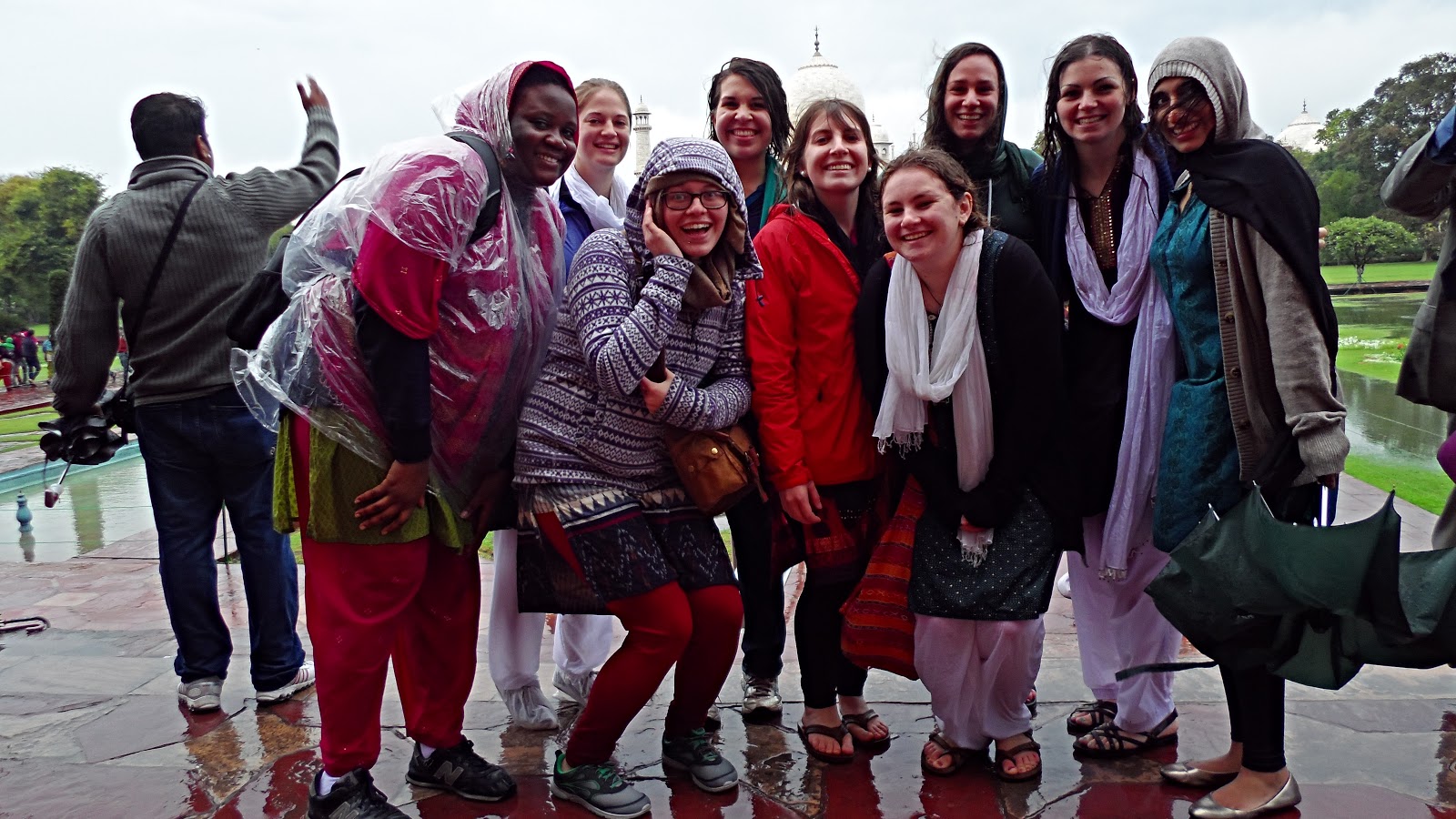
Clockwise: Me, Julika, Chrissy, Julia, Priyanka, Sarah,
Emily (sleeping already), Michelle, and Erika
The day started at 6:30am when we loaded into a "Tempo Traveler" that I had booked online.
The driver didn't speak much/any English, so it was a tiny bit of a struggle to explain to him that we needed to pick up one of our adventure companions before heading to Agra. But he got the point across and we were off!

A map would tell you that from Delhi to Agra should take about 2.5 hours. Well, double that. It took us FOREVER to get there. Granted we did have a few pauses in the travel. There were some pit stops at gas stations (I am actually diggin' the Eastern style toilet now), and a run in with a monkey/owner.

There is a scam type thing where men have adorable monkeys on leashes and teach them to do tricks. Well, we were stopped on the highway as the driver was dealing with some road tax stuff, and a monkey-guy came next to the car. One of my travel companions decided she wanted to take a picture of the adorable money as she (the monkey) was hanging onto the side of the van with a baby monkey in her arm. That was a mistake. The guy immediately started demanding 100 Rupees. And when I say demanded, I mean he and his friends were banging on the windows and the side of the van, opening a window and putting his hands through and yelling at us about money. Luckily the doors were locked and just as we were getting super uncomfortable with the situation the driver came back and we bolted away down the bumpy highway again.

When we finally got to Agra, we were starving. Our "guide" who was a part of the taxi service, had us go to a place with "Continental" food cause we said "no Indian please!" Thats all we've been eating, so it was time for a break. During lunch it began to rain. We didn't want to postpone going to the Taj so we decided to just tough it out and head on over.

In an attempt to protect the Taj from pollution, no gas/CNG vehicles are allowed near the property. So you park far away and then electric cars take you to the gates. There are also some camels towing carts, but we opted for the cars.
We paid our IR750 (about USD15), avoided some ginormous puddles, got patted down, and got our bags checked and BAM! We were inside the main red walls of the Taj.

The Great Gate. The building you walk through to get to the Tomb.
The red wall that you can see extending from either side of the Gate Building wraps forward (towards where I took the picture from), and there are little archways and a roof/awnings for the entire length of the red sandstone wall.

As soon as we were done being frisked (a very normal occurrence when going to popular places in India) the rain started really coming down. We sought refuge under the roof of the red walls to see if the rain would stop. It didn't.

We scurried from our spot in the wall around the lawn and squeezed into the Gate Building. This is where you look up above the heads of all of the short Indians and tourists and you are breathless and amazed at the sight you see through the archway.


You can't really tell from the picture, but the sheer size is what hits you first.
It was so rainy that there was a kind of water screen in front of us.

A few of us decided to just brave the rain and venture outside.


But then the rain turned from drops to absolute torrential downpour. We ran up the walkways and into the right side (not in this picture) mosque. There are mosques on either side to help weigh down the floating marble platform that the Tomb (the main white building) sits on. Because the location had experienced a horrible earthquake, the architects planned the platform so there would be less of a chance of it being destroyed. The four minarets are also constructed with a slight lean away from the Tomb so in the case of an earthquake or it they collapsed because they are so tall, they wouldn't affect the Tomb.

The rain just wouldn't let up! I was getting antsy in the mosque and my Oregonian-love-of-rain took over. I decided to go out and dance a bit in front (really the side) of the Tomb.

The scale is so hard to capture. If you see those little dark specs at the base of the Tomb, those are people walking around (in the rain). The carved arches on the base are taller than me.
Because the rain wasn't letting up, we decided to make our way up to the Tomb.
You can't wear your shoes on the marble, so you either have to take them off or put shoes covers on.

When I first made it up the stairs (so much pushing and crowding because no one wanted to be in the rain) I was separated from the three other girls I was with. So, I decided to seek refuge in one of the archways of the Tomb so I could see them when they came up.

To the right is us (our fourth adventurer, Julika, was taking the picture). Here you can see our glamourous shoe covers, the intricate carvings, and the amazing inlays. You also might notice how soaking wet we are.
My sweatshirt is usually a medium colored forrest green, and it was practically black (like my leggings) from all of the rain.

Once we had all recovered from the stairway experience and also taken photos with some of the Indian men sharing our archway (they wanted a full group shot with us girls in between each of them, and each guy wanted a picture with me ... very strange) we decided to make our way to the entrance to the Tomb.

Some of the detail at the entrance to the Tomb.

Don't get me wrong, the inside of the Tomb is cool, but the outside is so much more impressive and interesting than the inside. You could almost visit the Taj without going inside, you wouldn't be missing much. However, I did really like walking around inside and touching all of the carvings and the inlays. It was a really cool feeling to know that I was touching carvings that were made 400 years ago.

When we got out of the Tomb, it was still raining.

This is the crowd at the top of the stairs to the Tomb. You can also see the downpour of rain.
These people were not very Oregonian, they were all using umbrellas.
I wasn't the best Oregonian either through I suppose because I didn't have a raincoat.
There was so much water that even the grounds were flooding.
Eye-spy: The little planters at the center of the "ground" are under the water.
Me (soaking wet) at the Taj!

The nine of us met back up at the Great Gate before heading back to the van. We were completely  soaked (see the "white" pants some of the girls are wearing are now see-through) but being there was an absolutely incredible experience.

On the van ride home.
Notice the new colors in the van now?
Once we got back to the van we decided buying some dry clothes was VERY necessary. The tour guide first took us to this expensive place where we refused to buy anything. So then we found a cheeper place and we all bought some clothes.

We stopped for some food and a bathroom before we left Agra and then we were off, back to Delhi.

The drive home was quite uneventful. We had major girl bonding (aka chatting, gossiping, laughing) but besides that there was no unusual activity. We stopped for the restroom a few times (us girls have small bladders) and a cup of hot coffee/tea/coco and got home around 11pm.

It was an absolutely fantastic day. Some people (like my host dad) expressed their disappointment for us that it was raining when we were there, but I think the rain made the experience better than it would have been otherwise. If it had been sunny I would have simply looked and admired the Taj. But because it was raining, I sought refuge in it. I took the time to really look at the details, be very present in the moments and find the "little" spaces of the Taj that could protect me from the rain. I felt I got to know the Taj in a way that I wouldn't have otherwise - if I had just been "visiting" it.

The Taj Mahal was absolutely magical. I am so glad we made the trip!